

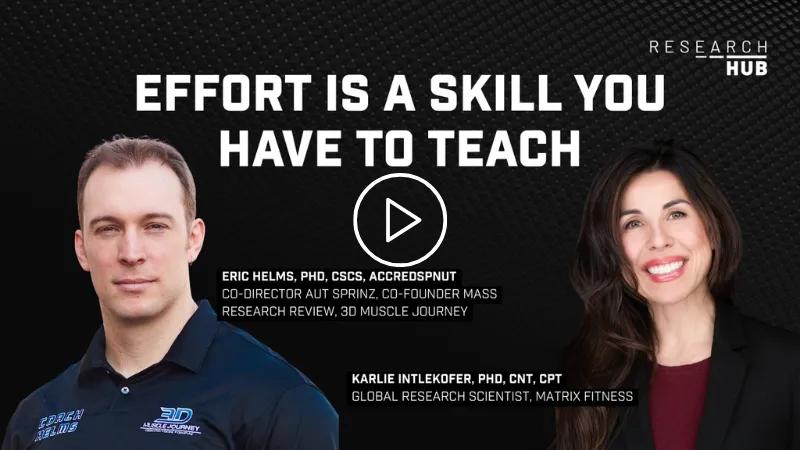
Solutions for Sustainable Progress in the Weight Room with Dr. Eric Helms
March 11, 2026


Listen on 

Key Concepts on Strength Training and Hypertrophy
Dr. Eric Helms explains that better strength and muscle results come from clear effort targets, supportive coaching, and flexible programming. Rigid plans or pushing every set to failure often work against long term progress.
Consistency and Effort Drive Results
- Supervision improves strength gains, adherence, and satisfaction. Coaching helps guide effort, correct form and technique, and add social support.
- Member self-efficacy, or the belief that “I can do this,” predicts long term persistence more than any specific set or rep scheme.
Tools to Calibrate Effort: RIR and RPE
- Repetitions in Reserve (RIR) estimates how many reps remain before failure and gives members a simple way to judge intensity.
- Rating of Perceived Exertion (RPE) can be used with RIR on a 10 point scale. For example, RPE 10 means failure, RPE 9 means about 1 rep left, and RPE 8 means about 2 reps left.
- High rep sets around 12 to 20 reps often reduce RIR accuracy because discomfort and breathlessness increase. Moderate rep ranges around 6 to 12 tend to improve accuracy and feel more manageable.
Program Design: Structured but Flexible
- Highly rigid programs can reduce adherence when life stress, fatigue, or poor recovery make targets feel unreachable.
- Autoregulation allows daily readiness to guide load, volume, or exercise selection. This approach protects recovery and supports consistency.
- The best program is the one a member can repeat week after week.
Applying Hypertrophy Principles
- Hypertrophy is the increase in muscle fiber size that comes from sufficient resistance and enough weekly training volume.
- Many loads and rep ranges can build muscle when effort is high enough.
- Sets performed close to failure with about 0 to 3 RIR or an RPE of 7 to 10 are usually enough to stimulate growth. Training to true failure often adds fatigue without extra benefit.
- More weekly training volume usually supports more growth up to an individual limit, so programs should adjust to the person.
- Machines and free weights produce similar muscle growth when effort and volume are equal. Selection should depend on safety, skill demands, and member preference.
- Compound lifts build skill and strength, while machines and isolation exercises help accumulate volume and allow safer training near failure.
Practical Coaching Implications
- Most commercial gym members train too light rather than too hard. Education and guided sets close to failure help recalibrate effort.
- Define failure carefully. Use technical failure for compound lifts and momentary failure for machines and isolation work.
Member progress depends on enjoyment, consistency, and appropriate effort. Coaches add value by helping members calibrate effort and build a positive relationship with training rather than chasing maximum discomfort.
Watch the full episode to hear Dr. Eric Helms explain the research and coaching strategies behind effective strength and hypertrophy programming.

